
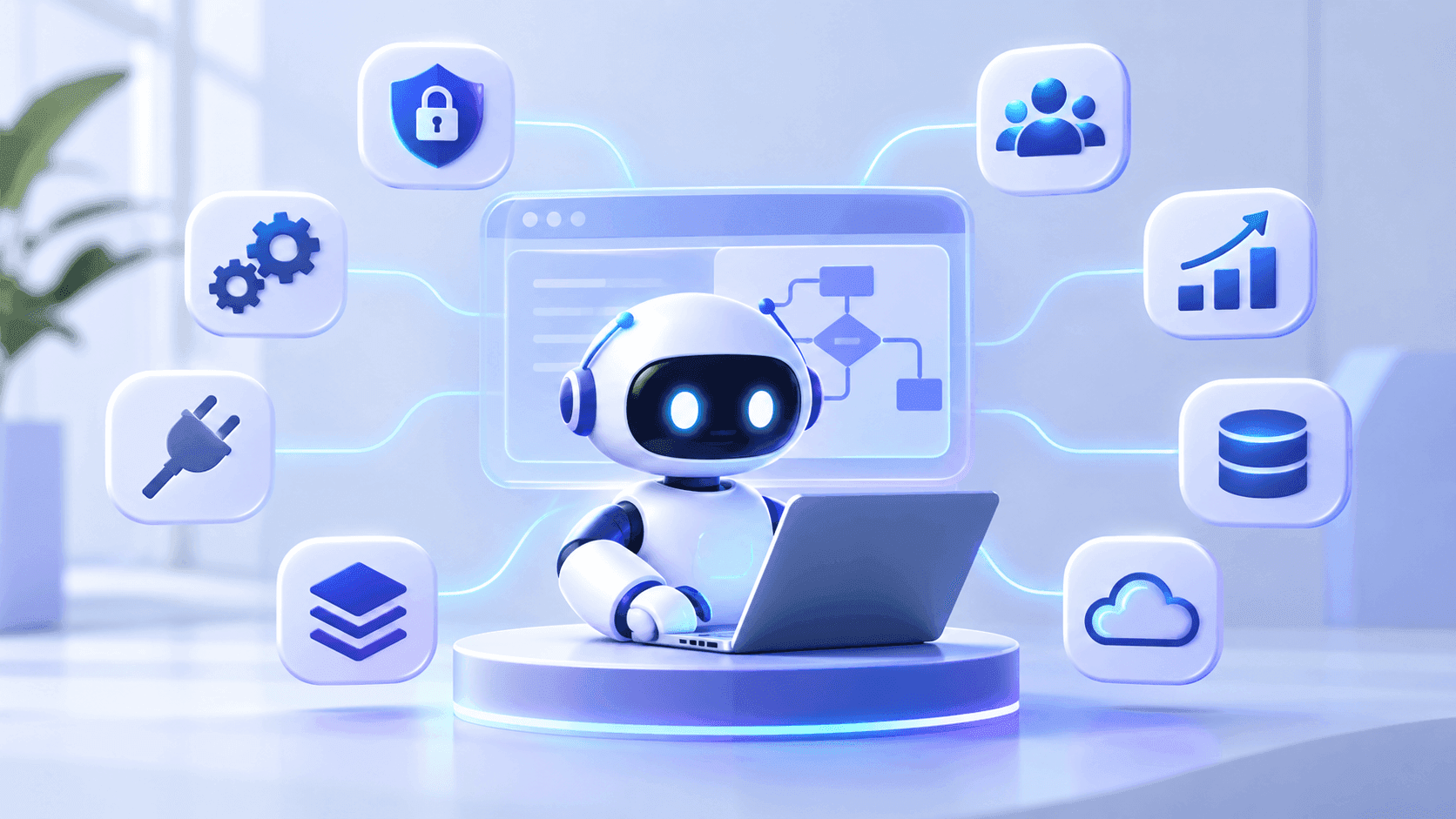
If you are wondering what should i look for in an ai agent platform, the answer goes beyond choosing a powerful AI model. A reliable AI agent platform should support your business objectives, connect with existing systems, protect sensitive information, and provide enough control to manage AI-driven workflows safely and efficiently.
AI agents are becoming increasingly useful for businesses that want to automate complex tasks, improve operational efficiency, and reduce repetitive work. Unlike traditional AI chatbots, AI agents can often plan tasks, use external tools, retrieve information, and perform actions within defined permissions.
However, not every platform offers the same capabilities. Some focus on building simple conversational agents, while others support enterprise automation, multi-agent workflows, and complex integrations.
Choosing the right platform requires a clear understanding of your business requirements, technical capabilities, security expectations, and long-term goals.
In this guide, we will explore the essential features, evaluation criteria, and practical considerations that can help you select an AI agent platform that meets your requirements.
What Is an AI Agent Platform?
An AI agent platform is a software environment that helps businesses develop, deploy, manage, and monitor AI agents.
These platforms typically combine large language models (LLMs), workflow orchestration, data access, tool integration, and monitoring capabilities to help agents complete tasks.
Depending on the platform, users may be able to build agents using visual interfaces, code-based frameworks, or a combination of both.
For example, an AI agent used by a customer support team might retrieve information from a knowledge base, identify the customer's issue, check an order through an API, and prepare a response.
A more advanced implementation could update an internal system or initiate a workflow, provided it has the necessary permissions and safeguards.
The key difference is that an AI agent can interact with systems and perform actions, rather than simply generating text.
This capability makes platform selection particularly important because the software must support both intelligent decision-making and controlled execution.
What Should I Look for in an AI Agent Platform? Key Features to Consider
The best platform depends on the specific workflow you want to automate. Nevertheless, several capabilities deserve careful attention during the evaluation process.
1. Security and Data Privacy
Security should be one of the first considerations when selecting an AI agent platform.
AI agents may access internal documents, customer information, business applications, and external services. If their permissions are poorly configured, they could expose sensitive information or perform actions that were never intended.
Look for a platform that supports role-based access control, secure authentication, encryption, and clear data handling policies.
It is also important to understand how the platform manages user permissions and whether agents operate using their own identities, delegated user access, or shared credentials.
The principle of least privilege should guide the implementation. In practical terms, an agent should receive only the access it needs to complete its assigned task.
For example, a customer support agent may need permission to view order details but should not automatically have permission to modify payment information or issue refunds.
Before choosing a platform, verify:
-
How customer and business data are stored and processed.
-
Whether your data is used to train AI models.
-
How access permissions can be restricted and revoked.
-
Whether sensitive actions can be blocked or require approval.
-
How security incidents and unauthorized access are handled.
These controls are particularly important when working with financial information, healthcare records, or confidential business documents.
OWASP identifies excessive agency, tool misuse, and prompt injection as important security concerns in AI agent systems. Therefore, security should be evaluated at both the model and application levels.
2. Integration Capabilities and API Connectivity
An AI agent platform should work with your existing business infrastructure rather than forcing you to replace essential systems.
Integration capabilities determine how easily agents can communicate with your CRM, ERP, customer support software, databases, project management tools, and other applications.
A platform with suitable integrations can reduce development time and help teams automate workflows across multiple systems.
However, the number of integrations alone does not determine their quality.
You should evaluate whether the platform supports the specific applications your business uses and whether those integrations provide the required functionality.
For example, connecting an AI agent to a CRM may allow it to retrieve customer information. However, if the agent also needs to update contact records, create opportunities, or assign leads, those actions must be supported and properly authorized.
Consider the following capabilities:
-
Native integrations with commonly used business applications.
-
REST APIs and other relevant integration methods.
-
Webhooks for event-driven automation.
-
Secure authentication and permission management.
-
Custom connectors for internal or legacy systems.
If your organization uses specialized software, confirm that the platform can connect to those systems without excessive custom development.
3. Workflow Orchestration and Multi-Step Automation
Workflow orchestration is another important feature to consider when evaluating an AI agent platform.
Many business processes involve several steps, decisions, and dependencies. A platform should be capable of managing these processes in a structured and reliable way.
For instance, an AI agent handling an incoming sales inquiry might:
-
Extract relevant information from the inquiry.
-
Identify the customer's requirements.
-
Check the CRM for existing records.
-
Assign the lead to the appropriate sales representative.
-
Prepare a follow-up message.
The platform should support these steps while allowing developers to define conditions, exceptions, and approval requirements.
It is also useful to understand whether the platform supports multiple agents working together.
Multi-agent systems can divide complex tasks among specialized agents. One agent might retrieve information, another might analyze it, and a third might prepare a report.
However, multi-agent architecture is not automatically better. It can introduce additional complexity, cost, and coordination challenges.
Choose a platform that supports the level of orchestration your workflow actually requires.
4. Model Flexibility and AI Model Selection
Different AI models have different strengths, limitations, costs, and performance characteristics.
A suitable AI agent platform should offer enough flexibility to select models according to your requirements.
Some tasks may require advanced reasoning, while others can be handled by smaller and less expensive models.
For example, an agent that classifies support tickets may not need the same model capabilities as an agent that analyzes complex legal documents.
When evaluating model flexibility, consider whether the platform supports:
-
Multiple AI model providers.
-
Different model sizes and capabilities.
-
Model switching when requirements change.
-
Model-specific configuration.
-
Fallback options when a model becomes unavailable.
Model flexibility can help reduce dependence on a single provider.
However, switching models may require adjustments to prompts, tools, evaluations, or workflow logic. Therefore, confirm whether the platform supports genuine portability or simply provides access to several models through a common interface.
5. Scalability and Performance
A platform that performs well during a small demonstration may behave differently under production workloads.
Scalability refers to its ability to handle increasing demand without unacceptable delays, failures, or operational complexity.
Before selecting a platform, consider how many agents you expect to run, how frequently they will execute, and how much data they will process.
For example, a company that automates 100 customer inquiries per day may have very different requirements from an organization processing thousands of requests every hour.
Evaluate:
-
Concurrent agent execution.
-
Request and API rate limits.
-
Response latency and task completion time.
-
Background and scheduled execution.
-
Retry mechanisms and timeout handling.
-
Monitoring of resource usage and system failures.
You should also ask vendors how their systems behave when an external API becomes unavailable or a model request fails.
A scalable platform should support your expected workload while making operational limits clear.
6. Human Oversight and Governance
AI agents can make mistakes, misunderstand instructions, or produce unexpected results.
For this reason, human oversight is essential when agents perform sensitive or high-impact tasks.
A suitable platform should allow businesses to define which actions agents can perform independently and which require human approval.
For example, an agent might automatically categorize customer support tickets but require approval before issuing a refund or changing a customer's account details.
The platform should also support clear escalation procedures when an agent encounters an unexpected situation.
Governance involves more than approving individual actions. Organizations should also be able to define policies, assign responsibility, review agent behavior, and update controls as requirements change.
The NIST AI Risk Management Framework provides a useful foundation for this process through its four functions: Govern, Map, Measure, and Manage.
These functions encourage organizations to establish accountability, understand risks, evaluate system performance, and manage risks throughout the AI lifecycle.
7. Monitoring, Observability, and Evaluation
An AI agent platform should provide visibility into how agents operate.
Without monitoring and observability, it becomes difficult to understand why an agent failed, which tools it used, or whether it completed a task correctly.
Look for features that help you review individual agent executions, including relevant inputs, tool calls, outputs, errors, and execution time.
Depending on the platform, useful capabilities may include:
-
Execution logs and traces.
-
Error reporting and alerts.
-
Performance dashboards.
-
Token and model usage tracking.
-
Evaluation of agent responses and task outcomes.
-
Version tracking for prompts, workflows, and configurations.
Evaluation is especially important because AI agent behavior can vary between executions.
A platform should support testing against representative examples before deployment and after significant changes.
For instance, a customer service agent should be evaluated on whether it provides accurate answers, follows company policies, avoids unauthorized actions, and escalates requests appropriately.
Monitoring should continue after deployment because real-world usage can reveal problems that were not identified during development.
8. Knowledge Management and Retrieval-Augmented Generation
Many AI agents need access to business-specific information to complete their tasks accurately.
Knowledge management capabilities help agents retrieve relevant information from documents, databases, websites, and internal knowledge bases.
Retrieval-Augmented Generation (RAG) is one approach used to combine information retrieval with AI-generated responses.
In a typical RAG workflow, the system retrieves relevant information from a knowledge source and provides it to the AI model as context for generating an answer.
This can help the model produce responses grounded in available information. However, RAG does not guarantee factual accuracy, so retrieval quality and answer evaluation remain important.
When evaluating a platform, consider:
-
Supported document formats and data sources.
-
Knowledge base synchronization.
-
Search and retrieval quality.
-
Metadata filtering and access controls.
-
Source attribution or citations.
-
Handling of outdated or conflicting information.
A business agent should also respect the permissions associated with the information it retrieves.
For example, an employee-facing agent should not expose confidential documents to users who are not authorized to access them.
9. Ease of Development and Maintenance
The development experience can significantly affect how quickly your team builds and maintains AI agents.
Some platforms provide low-code or no-code interfaces that allow business users to create workflows with limited programming.
Others offer SDKs, APIs, and development frameworks that provide greater flexibility for technical teams.
Neither approach is universally better.
A low-code platform may be suitable for standard business automation, while a code-first environment may be preferable for complex applications that require custom logic.
Evaluate whether the platform provides:
-
Clear documentation and practical examples.
-
Visual workflow builders or development SDKs.
-
Debugging and testing tools.
-
Version control and deployment support.
-
Collaboration features.
-
Customization options.
You should also consider the skills your team already has.
A platform that requires specialized expertise for every minor change may increase long-term maintenance costs.
10. Cost, Pricing Transparency, and Total Cost of Ownership
Pricing is another important factor when comparing AI agent platforms.
The advertised subscription price may not reflect the full cost of operating an agent in production.
Depending on the pricing model, costs may include platform subscriptions, model usage, API calls, execution time, storage, integration development, and ongoing maintenance.
Human review and exception handling can also contribute to operating expenses.
Before committing to a platform, ask vendors how they calculate charges and whether they provide usage monitoring.
Estimate the total cost of ownership based on your expected workload rather than relying solely on introductory pricing.
For example, an inexpensive platform may become costly if it requires extensive custom development or frequent manual intervention.
A more expensive option may offer better value if it reduces maintenance effort and supports your requirements with fewer additional services.
The goal should be to understand the overall business value, not simply to select the lowest-priced product.
11. Deployment Options and Vendor Lock-In
Deployment flexibility can become important as your business grows.
Depending on your security, infrastructure, and regulatory requirements, you may need a cloud-based service, a private environment, or a deployment model that integrates with your existing infrastructure.
Not every platform supports every deployment option, so verify availability directly with the provider.
Vendor lock-in is another consideration.
A platform may rely on proprietary workflow definitions, specialized tools, or model-specific features that make migration difficult.
Before making a decision, understand whether you can export workflows, configuration files, evaluation datasets, logs, and other relevant assets.
Also consider whether the platform supports standard interfaces and whether your agents can be migrated without rebuilding the entire system.
Portability is not always essential, but understanding the limitations early can help you make a more informed decision.
How to Evaluate an AI Agent Platform Before Making a Decision
After identifying your requirements, the next step is to compare platforms using a consistent evaluation process.
Rather than relying on marketing claims or demonstrations, test the platform against a real business workflow.
Start With a Specific Business Use Case
Define the problem you want to solve before evaluating vendors.
For example, you may want to automate customer support ticket classification, sales lead qualification, document processing, or internal knowledge retrieval.
Establish what the agent should accomplish, what information it can access, and which actions it is permitted to perform.
This will help you distinguish essential features from unnecessary complexity.
Create a Practical Evaluation Scorecard
Use the same evaluation criteria for every platform to reduce the influence of subjective impressions.
| Evaluation Area | What to Assess |
|---|---|
| Security | Access control, privacy, and permission management |
| Integrations | Compatibility with required business systems |
| Workflow automation | Multi-step execution and exception handling |
| Model flexibility | Supported models and switching options |
| Scalability | Performance under expected workloads |
| Governance | Approval workflows and policy enforcement |
| Observability | Logs, traces, and evaluation tools |
| Knowledge retrieval | Accuracy and relevance of retrieved information |
| Development | Ease of building and maintaining agents |
| Cost | Total operating and maintenance expenses |
Assign weights based on your organization's priorities.
For a highly regulated business, security and governance may deserve greater weight than ease of development.
For a small team automating routine tasks, development speed and total cost may be more important.
The scorecard should support your decision rather than replace technical and business judgment.
Run a Proof of Concept
A proof of concept (PoC) helps determine whether the platform can meet your actual requirements.
Use representative data, realistic workflows, and relevant edge cases.
Measure task completion rates, error frequency, execution time, operating costs, and the amount of human intervention required.
Test what happens when an agent receives incomplete information, encounters an unavailable tool, or attempts an action outside its permissions.
A successful demonstration is not sufficient evidence of production readiness.
The platform should also perform reliably under realistic operating conditions.
Common Mistakes to Avoid When Choosing an AI Agent Platform
Organizations sometimes select platforms based on impressive demonstrations or the number of advertised features.
However, several common mistakes can lead to poor implementation outcomes.
Choosing based only on model quality: A powerful model cannot compensate for weak integrations, poor workflow design, or inadequate security controls.
Ignoring business requirements: Selecting a platform before defining the intended use case can result in unnecessary complexity and expenses.
Overlooking security risks: Giving agents broad access to business systems without appropriate controls can create serious operational and data security problems.
Assuming automation means complete autonomy: Many business processes still require human approval, especially when actions involve financial transactions, sensitive data, or customer accounts.
Ignoring maintenance requirements: AI agents need monitoring, testing, updates, and ongoing evaluation. These responsibilities should be considered before deployment.
Scaling too early: Expanding an agent across multiple departments before validating its performance can increase costs and operational risks.
A gradual implementation approach allows organizations to identify weaknesses and improve the system before broader deployment.
Choosing the right AI agent platform requires more than comparing features or selecting the latest AI model.
Businesses should evaluate security, integrations, workflow orchestration, scalability, governance, monitoring, and total cost of ownership before making a decision.
The most suitable platform is one that addresses a clearly defined business problem, fits your existing infrastructure, and provides the controls needed to operate AI agents responsibly.
Start with a practical use case, establish measurable requirements, and test shortlisted platforms using realistic workflows.
This approach can help your organization make a more informed investment and build a reliable foundation for AI-powered automation.
Ultimately, successful AI agent implementation depends not only on the platform itself but also on how effectively it is designed, managed, evaluated, and integrated into your business operations.
Frequently Asked Questions
What is the most important feature of an AI agent platform?
There is no single feature that is most important for every organization. Security, integration capabilities, workflow orchestration, and observability are generally important, but their relative priority depends on the intended use case and business risks.
Are AI agent platforms suitable for small businesses?
Yes. Small businesses can use AI agent platforms to automate repetitive tasks, manage customer inquiries, organize information, and support internal workflows.
However, the platform should match the business's technical resources, budget, and automation requirements.
What is the difference between an AI agent platform and an AI chatbot?
An AI chatbot primarily focuses on interacting with users through conversations.
An AI agent can often go further by planning tasks, using tools, retrieving information, and performing actions within a defined environment.
Some modern chatbots also support agentic capabilities, so the distinction depends on the specific product and implementation.
Do AI agent platforms require coding?
Not necessarily. Some platforms provide visual builders and low-code interfaces.
However, more advanced use cases may require programming, API integration, custom tools, or technical configuration.
How can I measure the success of an AI agent platform?
Measure success using metrics related to your business objectives.
These may include task completion rate, accuracy, processing time, cost per task, error rate, customer satisfaction, and the percentage of tasks requiring human intervention.
The most useful metrics are those that demonstrate whether the platform delivers measurable improvements over your existing process.
Axel-Philippe Guehi
Related articles
Why Is Artificial Intelligence Development Transforming Businesses in 2026?